
(805) 261-2630
sales@selectramps.com
Mon-Fri: 9AM - 6PM PST
(805) 261-2630
sales@selectramps.com
Mon-Fri: 9AM - 6PM PST
(805) 261-2630
sales@selectramps.com
Mon-Fri: 9AM - 6PM PST
(805) 261-2630
sales@selectramps.com
Mon-Fri: 9AM - 6PM PST

A motorcycle hitch carrier is a rack that slides into the hitch receiver of a truck, SUV or RV and carries a bike behind the vehicle, with no trailer. Whether it works for you comes down to three numbers: the tongue weight your hitch can carry, the weight of your bike, and the width of its tires. This guide shows how to check each one.
A hitch mounted motorcycle carrier is a platform with a tire track, a front wheel chock, tie down arms and a loading ramp. The bike rides sideways across the back of the vehicle. It is also called a receiver hitch motorcycle carrier, a trailer hitch motorcycle carrier or a motorcycle hitch rack. A dirt bike hitch carrier and a scooter hitch carrier are the same design. Only tire width and weight change.
The carriers in this guide are the six MotoTote motorcycle hitch carriers we stock. All six are powder coated steel and mount to a standard 2 in receiver.
Check the vehicle before you compare carriers. The hitch holds all of the weight, so the number that matters is tongue weight, not towing capacity.

Look for the tongue weight rating on the hitch label and in the owner's manual, and use the lower of the two. If you only know the towing capacity, our fit calculator estimates tongue weight as 10 percent of it. A 5,000 lb towing capacity works out to 500 lb of tongue weight.
Some labels list two ratings, as in the photo above. A hitch carrier uses the weight carrying row, not the weight distributing row. On that label the limit is 500 lb.
Use the wet weight of the bike, with fuel and fluids. Then add the carrier. Our calculator adds 60 lb for a single carrier, so 500 lb of tongue weight leaves room for a 440 lb bike. The dual carriers weigh 101 lb and 106 lb, so use the real figure for those.
MotoTote calls for a Class III or IV hitch with a 2 in receiver. An aftermarket hitch has its own tongue weight rating, and it can be lower or higher than the vehicle's.
Measure the width of the front and rear tires and the wheelbase. The single carriers fit wheelbases up to 65 in. Tire width decides which model fits, as the table below shows.
To skip the math, pick your vehicle and bike in the vehicle and bike fit calculator. If you already have your numbers, enter them in the carrier fit calculator.
A motorcycle carrier for a truck is often the simpler case, since many pickups come with a Class III or IV hitch. A motorcycle carrier for an SUV needs a closer look, because tongue weight ratings vary widely between models. On the single carriers the tire track sets 16, 18 or 20 in from the vehicle, which helps clear a bumper or a spare tire. For a larger spare or a recessed RV hitch, the Extended Hitch Connection adds 11 in between the vehicle and the carrier.
A 600 lb motorcycle hitch carrier covers most dirt bikes, dual sports, scooters and many street bikes. The m3 is rated 500 lb, and the Sport, Max and Max+ are rated 600 lb. Shoppers also search for a 1,000 lb or heavy duty motorcycle hitch carrier. The carrier rating is only half of it: bike and carrier together still have to fit under your tongue weight rating. So the best motorcycle hitch carrier is the one that fits your hitch, your bike weight and your tires.
Weight picks the capacity. Tire width picks the model. A dirt bike or scooter on standard tires fits the m3 or the Max, which take rear tires up to 6 in and front tires up to 4.75 in. The Sport takes rear tires up to 8.5 in. The Max+ takes the widest tires: up to 9 in at the rear and 5.5 in at the front.
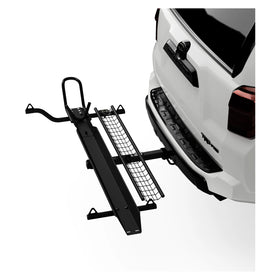
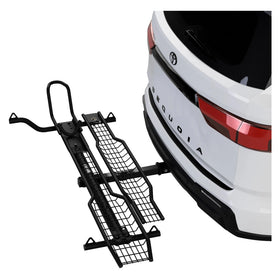

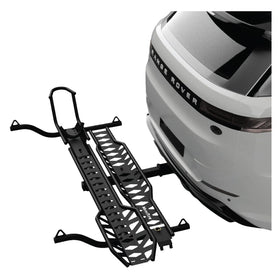
A dual motorcycle hitch carrier, also called a double motorcycle hitch carrier, holds two bikes on two tracks. The Max Dual and Max+ Dual carry up to 600 lb combined, with a 250 lb maximum on the outer track. Both include the parts to convert back to a single carrier.
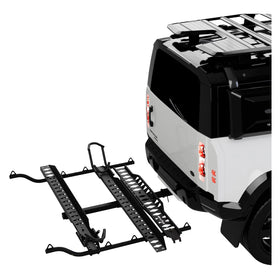
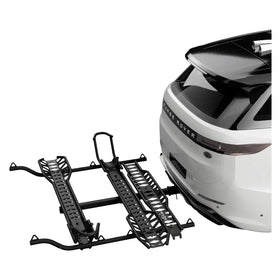
Carriers are built in steel or aluminum. Aluminum weighs less, and every pound of carrier counts against tongue weight. The MotoTote carriers here are steel. The single models that list a weight are 59 to 60 lb. A hydraulic motorcycle hitch carrier lowers the platform to the ground so you do not push the bike up a ramp. We do not carry one. The MotoTote carriers load with a 56 in ramp.
All six are powder coated steel, fit a standard 2 in receiver, include a 56 in loading ramp, carry a 1 year limited warranty and ship free. Capacity is the weight of the bike or bikes.
| Carrier | Bikes | Bike weight capacity | Front tire, up to | Rear tire, up to | Tie down arms | Best for |
|---|---|---|---|---|---|---|
| MotoTote m3 |
1 | 500 lb | 4.75 in | 6 in | 29 in front | Dirt bikes and scooters on standard tires |
| MotoTote Sport |
1 | 600 lb | 5 in | 8.5 in | 29 in front, 18.5 in rear | Dual sports, scramblers and sport bikes |
| MotoTote Max |
1 | 600 lb | 4.75 in | 6 in | 29 in front and rear | Dirt bikes and scooters, strapped at both ends |
| MotoTote Max+ |
1 | 600 lb | 5.5 in | 9 in | 29 in front and rear | Wide tire bikes |
| MotoTote Max Dual |
2 | 600 lb combined | 4.75 in | 6 in | 29 in front and rear | Two bikes on standard tires |
| MotoTote Max+ Dual |
2 | 600 lb combined | 5.5 in | 9 in | 29 in front and rear | Two bikes on wide tires |
See every model in motorcycle hitch carriers, or the full MotoTote range with add-ons and parts. For electric bikes, the MotoTote Mini is an e-bike hitch rack for one bike up to 200 lb with tires up to 5 in wide. The two-bike version and the ramp bundles are in e-bike hitch racks. To load into a pickup bed instead, see motorcycle ramps.
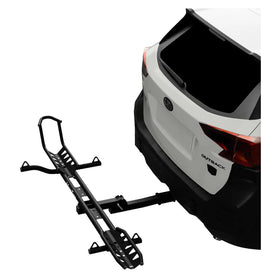
Read the instruction manual for your carrier first. Assembly takes 30 to 60 minutes for the single carriers and 45 to 90 minutes for the duals. Load on level ground with the vehicle in park. Roll the bike up the ramp into the tire track and seat the front wheel in the chock. Strap the front of the bike to the tie down arms, then secure the rear tire. Recheck every strap after the first few miles.
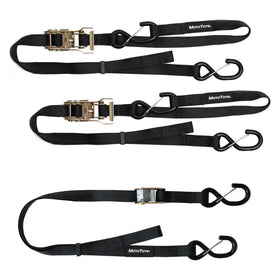
Straps are sold separately. See motorcycle tie down straps for bundles by bike type. MotoTote recommends the Universal Tie Down Bundle for most motorcycles. Carrier accessories include the LED Light Kit and an anti-rattle hitch tightener.
It depends on the carrier and on your hitch. Of the MotoTote carriers here, the m3 is rated for a 500 lb bike and the Sport, Max and Max+ for 600 lb. The dual carriers hold 600 lb combined. Your hitch tongue weight rating has to cover the bike plus the carrier, and it is often the lower number.
Only if it has a 2 in hitch receiver and enough tongue weight capacity for the bike plus the carrier. MotoTote calls for a Class III or IV hitch. Many cars and small crossovers do not have that rating. Check your owner's manual and the label on the hitch before you buy.
Not in this collection. The MotoTote carriers we sell are rated up to 600 lb. A higher carrier rating does not raise what your vehicle can carry: a 1,000 lb bike plus a carrier needs a hitch rated for that much tongue weight. Bikes that heavy are usually moved on a trailer.
Yes, with a dual carrier. The Max Dual and Max+ Dual each carry two bikes up to 600 lb combined, with a 250 lb maximum on the outer track. The carriers weigh 101 lb and 106 lb, so count that against your tongue weight as well.
Straps are sold separately, so order tie downs with the carrier. You need straps for the front of the bike and one for the rear tire. MotoTote recommends its Universal Tie Down Bundle for most motorcycles. Check the working load limit of each strap against the weight of your bike.
A bike on a carrier can cover the tail lights and license plate of the vehicle. Many states require both to be visible, and the rules vary, so check your local laws. MotoTote sells light kits that plug into a standard 4-prong trailer connector.
This guide is general information. Vehicle, hitch and motorcycle ratings vary. Confirm towing and tongue weight ratings with your vehicle and hitch manufacturer, check current product specifications, and check your local road rules before you buy or load.